Friday, June 24, 2016

When time stood still

When time stood still


The year was 1972. The place was Port Elizabeth, South Africa. The destination was the drive-in movie theater close to Marist Brothers, where I would go to school for a year (Marist Brothers that is, not the drive-in theater) and play Rugby and water polo.   Two sports I was not that great at. Soccer was to be my thing. By the way, the school is no longer there, but I digress. 


Marist brothers

My stepfather, Tom Martin, was driving (yes, that means my name was Steve Martin back before the name became famous with a comedian/actor who also does magic).  I was in the passenger seat. My younger brothers, David and Barry, were in the back seat.

Now Tom had a huge car, it was basically a tank, and I am going to guess that most Americans have not heard of the make, let alone the model, it was a gray Wolseley. Wolseley was a British Motor Vehicle company that was founded in 1901 by the Vickers armaments. The company was bought by William Morris and became part of that Empire. 

Now I am not really sure which Wolseley we owned, but I suspect that it was the Wolseley 6/110, also known as the Wolseley 300 in Denmark, as seen below:


What I do know is that my stepfather once wrecked it into a tree further down the same road as the one in this story, at the section where Main Street intersects the road in this story. He ran head-on into a stone wall, backed by dirt and a huge tree. The stone wall was destroyed even though it was backed by dirt, and the Wolesley had nary a scratch. At that time, there was a farmhouse in the background, and the wall was made out of large boulders. Now it appears to be a parking lot. The big trees are still there, as can be seen in the picture, plus a nice new yet lower lying brick wall.


The Wolesely was considered the finest "area car" ever employed by the London Metropolitan Police Force. This car had a top speed of 97.6 miles per hour and 0 to 60 in 14.4 seconds. I mention this speed and the fact it was fitted with drum breaks at the rear and vacuum servo assistance as a side note due to the fact I remember the first week we arrived in Port Elizabeth, after a long train ride from Johannesburg, my stepfather was refitting the Lockheed fitted drum bakes, when he was done he drove it head on towards me at a wall and hit the breaks. To show me "they worked."  Yes, I was between the wall and the car, and I was scared shitless. But I digress. Let's get back to: "This vehicle was a tank.” 

We made the right off Cape Road and headed down what is now known as the William Motley Expressway. Now the Motley Expressway is quite steep as you come down the hill from the Newton Park area. As you get further down, it evens out more somewhere between Lily Street and Main Street. And it is what happened there that I remember and will remember till the day I die.

I can still see it quite plainly. A black man was on the side of the road to the right ahead of us. He looked and started to step onto the road. My stepfather slowed down a bit, the man stepped back on the curb, we sped back up to our regular speed, then he just for no reason, jumped out into the middle of the road. It was at that moment that time stood still, or slowed to a very low speed for me. The man hit the front of the car. I could see him slide up the front of the car and fly slow motion up into the air. Our car spun for what seemed like many minutes, and we slid to a bumpy stop. I could see him land due to the fact that the car had swung 180 degrees around. My youngest brother Barry was in the back seat screaming, “Daddy hit a native, Daddy hit a native.” Keep in mind the context of apartheid at the time. Native was a very nice description of a black man compared to the horrible labels white Afrikana’s gave the black man then. Apartheid was horrific. And at some future time, I might write of my experiences of being an English boy in South Africa and not understanding why white Afrikana’s treated black people the way they did. But again, that is a story for another time. This story is about time, and to tell it, I need to finish the story.

Time stood still; even opening the door took time. Looking down, I thought I was covered in oil, but it was blood, looking dark under the amber street light. Slowly, I turned. The man was in the road, and his leg was hanging off. I remember some neighbors coming over, wrapping his leg in newspapers till the ambulance came. Slowly, things started to speed up with the passage of time as we know it. But time had surely almost stopped. Even now, I can see his shoe flying over the car as if it hung in the air, levitating in slow motion. Time had slowed to a halt during this, and time had crept up to its regular speed after we stopped. Now this was not the first time this had happened to me, but it is the one I remember because indeed it was the one time that time, as I knew it slowed down the most. And the one time a man may have died. The other times it slowed, but not so that I could see every single thing and detail, as if one minute was an hour.

To end this story, I should say that the man was taken to the hospital. A few weeks later, when the police came to the apartment in Kabega Park, we asked about him. It appeared that they had lost track of him. How does that happen? Well, during apartheid, it tragically happened all the time. Black lives simply did not matter to the white Africana.

This brings me to last week. Last week in Vegas, I was driving down a back street called Shelbourne. I stopped at a stop sign. There was a wall to my right, and the stop was way too far back from the end of the wall. I could only see a small part down the road. I proceeded to cross Placid Street, because I had been looking mostly to my right. I looked to my left, and when I looked back to my right, there was a blue Pathfinder just yards from me heading at my car full speed. 


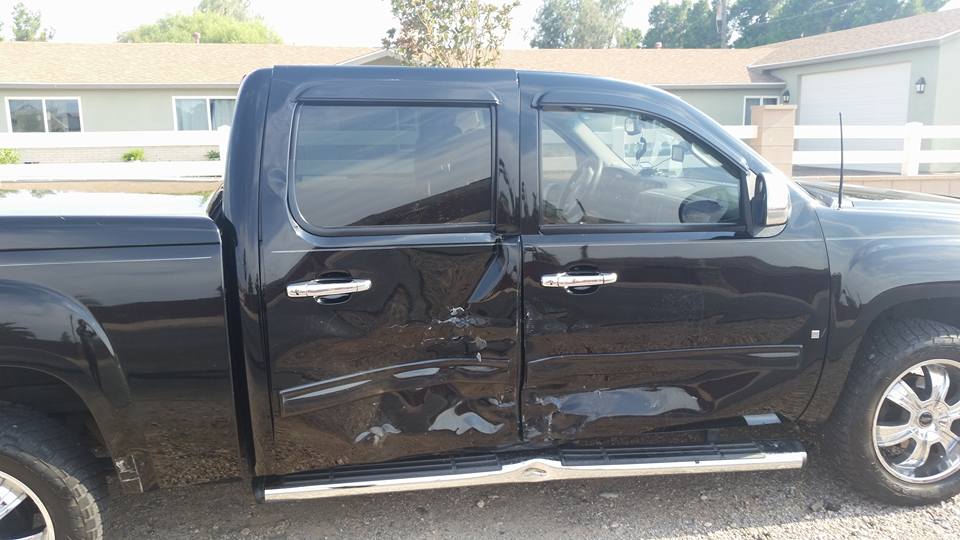
Again, time slowed, not as much as that first time but enough for my brain to go into overdrive. I knew at that speed he was going to hit the front of my vehicle, and if he did, I would probably die. So instead of hitting the breaks I hit the gas. He slammed into the side panel between the front passenger and rear passenger doors. The strongest part of my car. Had I not reacted the way I did, I would probably not be typing this right now. The pictures do not do justice to the damage to my vehicle. That side was pushed in at least a foot. But here is the interesting thing (other than both of us walking away from the wreck that is), I remember each and every thought that came to me as if it was happening in very slow time, I remember each and every detail, seeing his horrified face as he knew the inevitable was about to happen, seeing his licence plate coming at me and thinking about all those things and seeing him come towards me at first fast then in slow motion, enough to react that fast and make changes that saved my life. In this case, once the collision took place, everything immediately went back to regular speed. 


Now I am not the only one who has had this experience; in fact, in 1892, in the Yearbook of the Alpine Club, geologist Albert Von St Gallen Heim wrote about this in reference to climbers. He stated that 95 percent of climbers who had an accidental fall reported experiences that included,

“A dominant mental quickness and sense of surety. Mental activity became enormous, rising to a 100-fold velocity or intensity. The relationships of events and their probable outcomes were overviewed with objective clarity. No confusion entered at all. Time became greatly expanded. The individual acted with lightning-quickness in accord with accurate judgment of his situation. (Noyes and Kletti, 1972, pp. 46–47)

Now, a hundredfold might seem to be a bit of exaggeration, but in my South African experience, it certainly did not seem to be out of the realm of possibility.


There seems to be the following phenomena in these moments of extreme immediate danger:

1. A slowing down and expanding of time

2. Acute focusing on a subject

3. An incredible reaction time from the data retrieved from that focus

4. Increased vision and hearing

5. Dominant mental quickness.

So what causes this, and is it a true phenomenon? Some recent studies have tried to recreate this phenomenon and have only succeeded to the point that the participants watching others fall at high rates of speed think their time falling was longer. As a result, these studies pointed to the passage of time not slowing down, but rather, there is a perceived overestimation of time. In one study done by Chess Stetson in 2007, he concluded, “we speculate that the involvement of the amygdala in emotional memory may lead to dilated duration judgments retrospectively, due to a richer, and perhaps secondary encoding of the memories. Upon later readout, such highly salient events may be erroneously interpreted to have spanned a greater period of time. (Stetson et al.)

Still, other studies ran numbers slightly faster than what was tracked by the human eye. In theory, the people should have been able to see the numbers if time slowed down. They did not. The experimenters again concluded that time did not stand still for them or slow down for them. 

I find issues with most of these studies. In each study, the people knew they were not in any real danger, such as during a free fall, and therefore, the flight or fight temporal distortion really would not have been stimulated. Maybe, just maybe, the human mind is smart enough to know when it should jump ship or not. The scientists should not be so quick to put this phenomenon down to “memory effects.”


So what would explain it? Well, Valtteri Arstila wrote in his paper the following from (Berridge and Waterhouse, 2003


“To begin with, the mechanism that could account for our experiences during the sudden life-threatening situations needs to fulfill at a minimum the following requirements: the mechanism needs to become active in such situations, it needs to activate fast, and it must have wide-ranging effects. The neuronal mechanism that fulfills these requirements is the locus coeruleus norepinephrine system, the main source of the neurotransmitter norepinephrine. The first thing to note about it is that it is (in addition to other things) part of a fight-or-flight response that humans and other primates have been postulated to exhibit. This response is triggered by a perception of a fearful and threatening situation, not threatening situations per se, and hence it is likely to play a role in the situations under discussion. Second, the phasic response (brief and high levels of discharge) of the locus coeruleus norepinephrine system to highly salient as well as task-relevant stimuli occurs with a short latency of 100–150 ms and actually precedes behavior (Aston-Jones et al., 1994, 1997). Thus, such activation is in accord with the fact that many accidents, like car accidents, last only a few seconds during which the effects could occur. Finally, given that noradrenergic neurons originating from locus coeruleus project exceptionally widely in the brain, the entire cerebral cortex, for instance, receives input from it, and that norepinephrine is one of the main neurotransmitters, it is unsurprising that the effects of released norepinephrine can be dramatic and wide-ranging. ”


All I know is that it is indeed a real phenomenon, perceived or not. I also realized that the older I get, the less time stands still. Now we do know the reason for this, or at least they say they do. It seems that as we get older, we lay down fewer memory tracks since we have "been there and done that" so many times, there is no reason for our brains and memory to lay down a new track. When one is laying down new tracks, time slows. Time often seems expanded when we focus on certain tasks. Look at a clock and watch the second hand; it will appear that time has slowed if you concentrate on each and every second movement compared to just sitting back and letting a minute tick by. 


A series of perceptions slows time down for us. Yes, this is perceived time, and that is what most of thetime we deal with in our lives, especially as we get older. But those special moments, those moments where time stands still, we react fast, we think fast, and we are superhuman.. Well, maybe it is just real magic and certainly the superpower I would want every day if I could have a superpower.. The power to make time stand still. Watch this video to see why :-)


Friday, August 7, 2015

What does the word mentalist mean?


As with anything, there are those who want to play semantics with words, and some will misinterpret the word 'mentalis't to mean what they want it to mean 


The word “mentalist”  has been used to describe “psychics” and in the U.K., has become a tongue-in-cheek insult for someone who is behaving strangely or is crazy, mostly thanks to the T.V. series “Alan Partridge” and “The Office.”  But what does it mean to us as psychic entertainers and magicians?

The word mentalist originally was used in the context for one "whose tastes are from mental rather than material pleasures" in a book published in 1790 by C.M. Graham.  In 1874, it became known to be associated in context of a mental action due to  H. Maudsley. Then, in 1978, it was popularized in the context of the medical profession for someone who behaves strangely in a book called “On Our Own” by Judi Chamberlin.

But in the context we tend to think of today, the context of the famous NBC TV show and of what we do as entertainers, it simply means someone who takes his known senses to create the illusion of reading minds or being a psychic.  The line, "I take my five known senses to create the illusion of a sixth," was first introduced by Ned Rutledge. who gave me permission to use and promote in my books.

The first documented printed use of this word in newspapers I can find was in the Trenton Evening Times in 1909. The earliest I have found for the term being used in reference to entertainers who “read minds” was in the 1870’s. 


Dunninger, who is thought of by many as being the modern father of mentalists who use tricks on stage, claimed he coined the word from the book  Kybalion (Hermetic Philosophy), published in  1908, where it states that, “The Principle of Mentalism embodies the truth that 'All is Mind.'"

So thinking about it, we may never know who actually coined the term in reference to demonstrations of Stage Mind Reading as I perform it.

Update to this article:

Found online in my research:  Here is a 1902 book, The Law of Mentalism, referenced below  https://archive.org/...age/n5/mode/2up

Also found: 

Discourse on Method by Descartes in 1637 establishes rules of effective thinking both in situations of certainty and uncertainty. Mentalism, however, while using rigorous methods, goes beyond focusing on knowledge of all aspects of the human mind.

Henry Sidgwick uses the word mentalism to oppose materialism. In 1874, he established the rules of thought based on clarity, coherence, and consensus, which transpose to the systematic mind that tends to operate against material objects.

Irish Bishop George Berkeley, in 1710, advocates immaterialism. George Berkeley introduced an idea called mentalism.  This theory stated that the mental function of knowledge was directly associated with the perception and the experiences of the individual.  This theory directly stemmed from Descartes theory of the body influencing the mind.  This theory of mentalism still directly affects the ideas of mental processes in modern psychology.  According to this doctrine, an adequate explanation of human behavior is not possible without reference to mental phenomena. The mentalists are of the opinion that the subject matter of psychology should be the mind, using introspection as the research tool.

His basic idea is that we create our own realities.

In 1902, A. Victor Segno published The Law of Mentalism, which obtained global success. It addresses the power on, and of, the mental faculties in all its forms, including hypnotism, telepathy, etc.


www.banachek.com

Join me on Facebook and Twitter at: 

https://www.facebook.com/Banachek
   
http://twitter.com/banachek


Friday, December 30, 2011

New Years Card Trick For You.


This is my version of an old Eddie Joseph effect. I love his thinking. 

I once posted it elsewhere and sent a copy on to Teller (the silent half of that brilliant duo), he liked it enough to put his own presentation together for his book, How to Play in Traffic. I gave them a few other things for the book, too, but that is another story. 

I thought you would enjoy it, so re-posting it here in the spirit of the season! Have fun 
........................................... 

A HAPPY NEW YEAR 

Okay, I want you to get a deck of cards. It must be a full deck. Remove the jokers; in fact, throw them away, and also throw away any advertising cards.  In other words, you need all 52 playing cards, no more, no less. 

Now, remove all the odd cards, this includes the Kings and Jacks. 

Set the even cards off to the side in a face-down pile for now. You should have 24 cards in this pile.

Pick up the odd cards and shuffle them as much as your heart's content. Now look at the top card and the bottom card, and add the values together. Aces would be one, Jacks eleven, Queens 12, and Kings thirteen.

Now, set the odd cards face down to the side and pick up the even pile. Note the card at that position from the top of the deck down while keeping the cards in the same order. 

In other words, if the total number of the two odd cards were 18, you would remember the 18th card down in the even pile, keeping the cards in the same random order when finished. 

Now, let us review the situation up to this point. The odd packet is on the table. And the even pack is in your hands, face down. You have two things in mind.... One, a certain number, and two, a playing card. 

If I were in hearing distance, I could tell you what that card is. On the other hand, I could wait until I hear from you, then disclose the identity of the card. But this might take too long, as it is Christmas and I have relatives to visit, and I do not have time to answer all of you. I could, of course, tell you right here what that card is, but then you would lose interest and not care to try this little experiment out to it's conclusion.

Therefore, I propose to do better... I shall try to find that card even though several miles separate us. I know you don't believe such a thing is possible, but I shall prove it to you in the next few minutes. 

Oh, I forgot one instruction; you will need a full deck to continue, so please place the ODD packet of cards on top of the even cards in your hand face down. 

Have you placed the ODD cards on top of the EVEN pile?? 

Good! 

Now deal out a row of cards face up corresponding with the total number you have in mind (the total of the two odd cards you added earlier). I am asking you to do this because I wish to impress that number deeper in your mind, as this number is your mystic number. Today, it is your lucky number.

Have you got the row of cards in front of you?? As I wish you to identify your personality with mine and the cards lying in that row, please spell out 

B A N A C H E K  R O C K S

Lay out one card from the top of the deck on each face card up on the table for each letter of that phrase (omit the space). If by chance you do not complete the spelling by the time you cover the last face-up card in the row, do continue again with the first card and carry through until finished. 

Done spelling that phrase? Good.

Okay, a little cheesy, but stay with me.

Look at the top card of the deck in your hand. Bet you thought that was going to be your card. No, Sir! It's not that simple, deal this card on the table.

I have a wish for you this Christmas season, and for it to come true, you need to spell out the wish, deal one card as before for each letter of my wish below. 

A H A P P Y N E W Y E A R 

Right, now cross your fingers and think of your card. Now turn over the top card of the deck. What do you see? Don't bother calling to tell me, I know. 

It is my wish for you.


www.banachek.com

Join me on Facebook and Twitter at: 

https://www.facebook.com/Banachek
   
http://twitter.com/banachek

Thursday, May 27, 2010

How to raise a heart rate in a baby.


At the time I wrote this, my granddaughter was 2 years old, Mikayla. She spent a lot of time with my (now ex- wife) Heidi and me. I have come to the conclusion that she needed us for different reasons. When she was tired, she wanted little if anything to do with me; in fact, she appeared to hate me. When it came to playing, she wanted to spend time with me, even to the point that she couldn't get candy without getting something for "GanPa."  Now this did not bother me in the least. The fact that Mikayla would rather spend time with me when it came to playtime, despite the fact that my ex-wife constantly gave her comfort, bothered my ex-wife. I simply put it all down to a biological nuance. Turns out that research says I am right.

       As the Scientific American Mind
                                             June 2010 states:


"Together, two parents may strike a nice balance in which mom acts as a 'lifeguard' and dad functions as the 'cheerleader.' "

You see, dads are biologically programmed to challenge children. In a study done in Australia, it turned out that dads spent approximately 40 percent of their child-watching time playing interactive games like reading or simple physical play, as opposed to approximately 20 percent of the same child-watching time for mothers. I know that most of my interaction with Mikayla is either outside on the swings or playing hide and seek, holding her up by her feet, and basically treating her like a monkey, in a good way that is. I don't do diapers. In fact, at the age of 2, she already uses the toilet because I simply told her to, so I would not have to change her nappies. The women in the family all say, "all in good time." To me, "good time" is "quick time" when it comes to stinky diapers. When my kids were very little (prior to most TV's having TV remotes), I taught my kids the joy of being a human remote. I turned it into a game; they loved it, and I did not have to get off the couch. For a while, my kids did a pretty good imitation of me, "change the channel, change the channel, back, okay, change the channel." Yeah, I would say I challenged my kids.

Kids as young as eight months old learn these pattern differences between a mother and father to the point that when a child is picked up by dad or a male, their heart rate increases, yet when picked up by mom or a female, they calm down. Fathers tend to be more physical in their play compared to mothers.

Researchers think that a lot of this stems from the fact that fathers traditionally are the breadwinners in a family and as a result spend less time on the caring aspect of child, like diaper changing, feeding, putting a child down for a nap, bathing, and cuddling.  I must admit, I have found a way to get my granddaughter's attention and love when she is tired. It took a while, but I found the magic answer: Chocolate Swiss Miss Rolls. It is like crack for children.  She can't throw the bottle down fast enough :-)  Hey, I'm "GanPa," and it is my job to spoil her.

As said earlier, dads tend to challenge their kids. In fact, the same article states that even though fathers speak less to their children, it was "the father's language use that predicted the child's language development by the age of three. Mothers use more emotional words, whereas fathers use more complex words to talk to their child." The other thing is that women will tend to play the games that a child chooses, men, on the other hand, tend to select the activity for a child to play (like my TV remote game), thereby challenging the child by causing a child to experience play outside their comfort zone and as a result experiencing growth.


The other amazing fact about fathers and children is that during pregnancy, fathers go through many of the pregnancy's biological changes too. Their testosterone levels go down ( a good thing as it quietens their physical tendencies males have), they have elevated levels of prolactin (which has many effects, including regulating lactation, orgasms, but primarily during pregnancy increases the size of mammary glands and produces milk), and men can even experience postpartum depression.


One thing in this article that I found of particular interest is the fact that it has been known that mothers can locate their babies blindfolded just by touch alone. Now turns out fathers can do the exact same thing. Sounds like a pretty good introduction line for a new blindfold routine.


www.banachek.com

Join me on Facebook and Twitter at: 

https://www.facebook.com/Banachek

Friday, May 21, 2010

Bats, echolocation and amazing people.

During my last years of high school and after I graduated from high school, I worked three jobs, one of which was at Washington Hospital, Washington, PA. My first job there was as a dish-washer; I had to clean food off plates that sick people had been eating off. Not a nice job. I remember one time my boss made me extremely mad. I was livid. I do not remember what for, but I do remember I made some sort of rude gesture at him behind his back. When he asked me what I was doing, I told him that I was "putting a curse on him so he would not be able to speak." Keep in mind, these were the days when people really thought I was psychic. Project Alpha (see website www.banachek.com for info on Project Alpha) was already planned to take place at some time, and Randi had asked me to pretend to be psychic. Well, lo and behold, whether it was due to his belief in my "powers," coincidence, or the very unlikely fact that I was psychic, he lost his voice for two weeks. This scared the bejesus out of everyone that worked with me, and to be honest, even scared me a little bit. I realized the power of words.

My second job at Washington Hospital was in housekeeping. Usually, you just strip the floors and put new wax on them or wash down the walls. The smoking rooms were the worst. Buckets of smelly, yellow water when you were done, just awful, and certainly kept me away from cigarettes. Once, I had to clean up the sidewalk where a person's brain lay splattered due to jumping out a window. Other times I worked the operating room, where, after a late Saturday night, I slept in the on-call doctor's bed until they needed me to mop up all the blood and guts on the floor. At that time, they also incinerated the amputated arms and legs. It was my job to take them to the incinerator, and that always bothered me. It was part of people they would never get back. I will never forget the smell of the cauterized flesh and the mixture of glues. It was awful.

One day, the housekeeping mothers (as we liked to call them) sent me up to an area that was not used anymore. Up in the attic of this old hospital. Scary as all hell, lots of cobwebs, old wooden wheelchairs and old medical paraphernalia. Reminded me of something you would see out of a horror film. This did not bother me much, but the reason they sent me did. To get rid of some of the only mammals naturally capable of "true and sustained flight": bats. I hated bats. I had believed all the old tripe about them, such as they get stuck in your hair, they suck your blood, they are blind, and that they all carried rabies. It took me a while, but I did manage to catch the few that were nesting up there, but I have to admit I was screaming like a banshee and laughing due to my fear the whole time as the bats weaved and darted all around me. I used a very crude technique of swatting them with a broom, a bucket, and throwing a large cloth over them. Took a while, but my task was fulfilled, and I vowed never again.

Turns out bats are pretty darn cool animals. Also turns out that bats are pretty clean creatures who groom themselves like cats do, and fewer than one percent of all bats ever get rabies. They do bite, but usually in self-defense. It also turns out they have excellent vision, and some, like the Pallid Bat, have big ears and excellent hearing. It also turns out that not all bats use echolocation for hearing. Microbats do, and all but one type of megabat do not.

Echolocation is the ability to use biological sonar to navigate or locate. In other words, some bats give out a sound and listen to the echoes of those sounds to locate and identify objects. The sound rebounds, and the difference in the time it is received and the intensity received by each ear allows the recipient to measure the horizontal angle. This allows them to perceive the direction of the objects, the density, and the distance.

At the time, this inspired me to use echolocation as one of the explanations to the press of how I was able to drive a car blindfolded, like in this footage of me from Evening Magazine.


Echolocation is a pretty amazing feat and thought in the past to only have existed in some animals like the aforementioned bats, shrews, dolphins, and crustaceans. Recently, though, it has become more apparent that humans can develop this sense as well.

Below is a video of an amazing kid, Ben Underwood, who uses echolocation to play video games and basketball.


It seems that even more blind people are being taught to use echolocation to navigate their environment, and yes, it is a skill that can be learned. It is a fairly new field, having only been brought to the attention of scientists since the 1950's. Most blind people who practice the technique, though, like to think that it is not a learned sense but inherent and intuitive. They liken the process to "feeling pressure" from items as they pass them.

When you think about it, it is quite logical that blind people would inherit this sense. Both vision and hearing are very closely related in how they work. They both use reflected waves of energy. Seeing uses light waves, and hearing uses sound waves. They both work off interpreting that reflected energy wave. The reflected waves via echoes can give detailed information about the location, dimensions, and density of items. This latter being very important as you can learn over time what that density means and associate it with what you already know. A hedge would be less dense than a wall and so forth.

Looking back at history, there are many documented cases of this amazing phenomenon. The first goes as far back as the late 1700s into the early eighteen hundreds when a man by the name of James Holman used the sound of his cane to travel the world.

In this day and age, a man by the name of Daniel Kish, who has been blind since he was 13 months old and uses a device to emit clicks and get around, teaches other teenagers to use the technique to the point where they even ride mountain bikes through the wilderness.

To me, this is just more proof that there are so many truly amazing things in the world that one does not have to look towards pseudoscience to find them. I love the amazing world we live in, and this is a perfect example of why.


www.banachek.com

Join me on Facebook and Twitter at: 

https://www.facebook.com/Banachek
   
http://twitter.com/banachek


Monday, May 10, 2010

Keep a Baby Picture in Your Wallet If You Want It Returned.


Back in the 1990's, I coached a kids' soccer team, St. Theresa's in Memorial Park, Houston, TX.  I was very proud that I took the last-place team and moved them up to the finals.  Despite all of that, there is one thing that always stood out during that time. When I started to work with the team, I lived near the school. During the season, we moved across town.  One day, I was drawing new lines out for the field in the hot Houston sun. I left, and lo and behold, my wallet had fallen out of my back pocket.  I went back but could not find it anywhere. I had pictures, money, and credit cards in it, and panicked pretty badly. Keep in mind that during the 90's, I had little money at the time and was pretty much private school poor with four kids in private school at the same time. Then something really amazing happened.  My wallet, like magic, appeared in my mailbox at my new home.  It was not in an envelope. Someone had actually taken the time to look up my address (prior to GPS's being the rage), and driven across town to deliver my wallet. Seeing I was not home, they simply dropped it in the mail slot.  No note, nothing.  I expected that there would not be any cash left. But I was wrong, everything was still where it should be, the cash, the credit cards, everything. It was quite a testament to the fact that there are still good people out there, and it left quite an impression on me to go above and beyond to do the right thing. I know how it made me feel.


Now if you lose your wallet, I can't guarantee that the same will happen to you, but I can tell you how to increase your odds that your wallet will be returned.

I have an incredible friend in England.  His name is Professor Richard Wiseman. If you have not heard of him, he is brilliant. Visit his website at:  


You may know him from his brilliant color-changing trick seen in this video.


Anyway, Richard always has some very interesting projects he is working on to find out how people think or react.  The one that concerns us here is the idea that "can what one finds in a lost wallet we come across actually influence us in some way as to what we do with that wallet?'

Richard had  240 wallets mixed and dropped around Edinburgh over a couple of weeks, and then had his team monitor which ones were returned to their proper owners. None of the wallets had any money inside like mine did, but they did contain other valuables like discount tickets, raffle tickets, and membership cards. They were secretly dropped on the streets in high foot traffic areas, but well away from "postboxes, litter bins, vomit, and dog faeces."

Prof Wiseman notes in an article in the May 10, 2010, New York Times Online  that this was not as easy a task as one would think:

"We dropped 200 or so wallets and tried to see if certain types of content would make people more likely to return them. That was funny, in part because it turns out dropping wallets is an absolute nightmare. It’s a social psychology nightmare because you have to drop them quite a distance from one another. You don’t want someone walking down the street, finding five wallets. So you have to walk about half a mile between each drop, and timing that by 200, it turns into quite a drawn-out study. And then you discover how difficult it is to drop a wallet these days. You drop a wallet, and you walk off, and then there’s someone behind you going, “Excuse me, you dropped this wallet.” And you’re kind of, “Back off, it’s science. Put it back exactly where I dropped it.” And the drop zones are very carefully calculated, so that they’re not too close to bins and letterboxes, so you’ve got to walk around the block and drop it again, and if the same person sees you, they think you’re insane. So those things were quite good fun. I dropped one wallet and sort of stood nearby to see if anyone picked it up. A policeman came along, picked it up, looked at it, walked over to a litter bin, and dropped it inside."

Some of the wallets were stuffed with receipts showing the person had just donated to a charity, and other ones had one of four photographs inserted in them behind a clear plastic window: a smiling baby picture, a picture of a cute puppy, a happy family picture, or a very content elderly couple. 

When all was said and done, only 42% of the wallets were returned in total. Surprisingly, 88% of those returned were the wallets that had the picture of the baby in them, compared to 53% for the dog, 48% for the family, and only 28% for the elderly couple.

When faced with the photograph of the baby, people were far more likely to send the wallet back. In fact, only one in ten was either unethical enough, hard-hearted enough or just did not care enough to do so. When there was no picture in the wallet to tug at the emotions, just one in seven were mailed back.

Now you would suspect that the wallets that contained the charity donation card would trigger a positive response for return, but this was not so; at 20 per cent and 15, the charity card and control wallets had the lowest return rates.  I can only speculate that the charity card actually triggered a response of, "Oh, they give to charity, so they have money to give away, they won't miss their wallet." Again, this is only speculation from me, and I am not a professor. Prof. Wiseman would be the one to ask.

So why does this work, Prof. Wiseman told The Daily Telegraph: “The baby kicked off a caring feeling in people, which is not surprising from an evolutionary perspective. We were amazed by the high percentage of wallets that came back."  The result reflects a compassion instinct towards the vulnerable infants that humans have evolved to ensure the survival of future generations.

So the lesson here is: Place a baby picture in your wallet; it can't hurt.  


I suspect that if you have a picture with you holding the baby and make sure it is in a prominent place in the wallet, it will help increase those odds even further. Again, no guarantee, as it is just a guess. More research would have to be done to bear this out. Placing a baby picture in your wallet is no guarantee that you will get the wallet returned, as I did at the beginning of this blog, but every little bit helps.

Scientists at the University of Oxford have also found evidence for a baby instinct in brain scanning experiments. A recent study at the University of Oxford examined how people responded when they were shown photographs of baby or adult faces. The photographs were all matched for attractiveness, yet activity in the section of the brain associated with empathy (ventromedial prefrontal cortex)  was much more responsive to the baby faces than to adult faces. According to the study, the response happened too rapidly to be consciously controlled in any way.

And one more interesting fact on babies that I will cover due to an upcoming tweet:  Fathers are less likely than mothers to hold their infant in a face-to-face position. Mothers are more likely to follow through with the child’s choice of topic in play, whilst fathers are more likely to impose their own topic. 

www.banachek.com

Join me on Facebook and Twitter at: 

https://www.facebook.com/Banachek
   
http://twitter.com/banachek


Sunday, May 9, 2010


The Science Of Diluting"Fuck" and Other Cuss Words With L Words


When I find I am stressed and start to use foul language more than I would like I think of L words.


Let me explain the real psychology in all of this. Usually, when one is upset, that is when one uses the F word, until it just becomes a habit, of course.


Anger is an emotion. As you become angry, your body's muscles tense up. Inside your brain, neurotransmitter chemicals known as catecholamines ("fight or flight" hormones that are released by the adrenal glands in response to stress) are released causing you to experience a sudden burst of energy lasting up to several minutes. 


Now, there are not that many L words that fit angry situations. Try, and you will not find them. By the time you have tried words like ludicrous, loquacious, lobotomoyabarum, labefactation, labeorphily, labidometer, labile, labrose, and even lallation and found none of them fit, you have slowed down the emotional anger process by distraction and restructuring of thoughts in order to bring about a casual reduction in anger, or in this case, an anger response that has become a habit. Habits are seen to be routines of behavior that are repeated and tend to occur subconsciously about them. So by using this stalling technique, you force yourself to think consciously about them and change that habit.


It is basically a relaxation technique that helps to decrease your amygdala activity and the use of cognitive control techniques, which help you practice using your judgment to override your emotional reactions. And if practiced soon enough will interrupt the flow of additional brain neurotransmitters and hormones (among them adrenaline and noradrenaline) being released, which trigger a lasting state of anger arousal and physical effects like increased blood pressure and increased heart rate.


Of course, you can just as easily use other letters that have hard-to-find anger words. Oh, and if you want a negative L word, try one of these:

  1. lapidat: to pelt with stones; to kill by stoning
  2. larrup: to flog or thrash
  3. libertinage: debauchery
  4. lickerish: lecherous; lusty; greedy
  5. limaciform:slug-like
  6. lubricious: slippery; lewd

If you still want an L-cus word sentence, try these French terms:


lèche-moi le cul: Lick my Ass

or


La putain de ta race: Whore of the Race.


Enjoy

https://www.facebook.com/Banachek  
www.banachek.com